866.249.6095

Is Your Vacation Rental Showing AI Agents the Wrong Price? It Could Be a Legal Risk

Some vacation rental websites are quietly feeding AI shopping assistants prices that are 35% to 45% lower than what guests actually pay. If your site is one of them, you could be breaking federal pricing rules without knowing it.
Travelers no longer just browse. More and more of them ask ChatGPT, Claude, Gemini or Perplexity to "find me a 6-bedroom in downtown Louisville for mid-November" and let the AI compare options. That AI reads your website the way a search engine does, and it quotes whatever price it finds. If that price leaves out your cleaning fee, service fees and taxes, the AI tells the guest your home costs far less than it really does.
We found a real example while researching a stay. Here is what happened, why it matters under the FTC's fee rule, and how to make sure your own site is not making the same mistake.
The example: one price for guests, a much lower one for AI
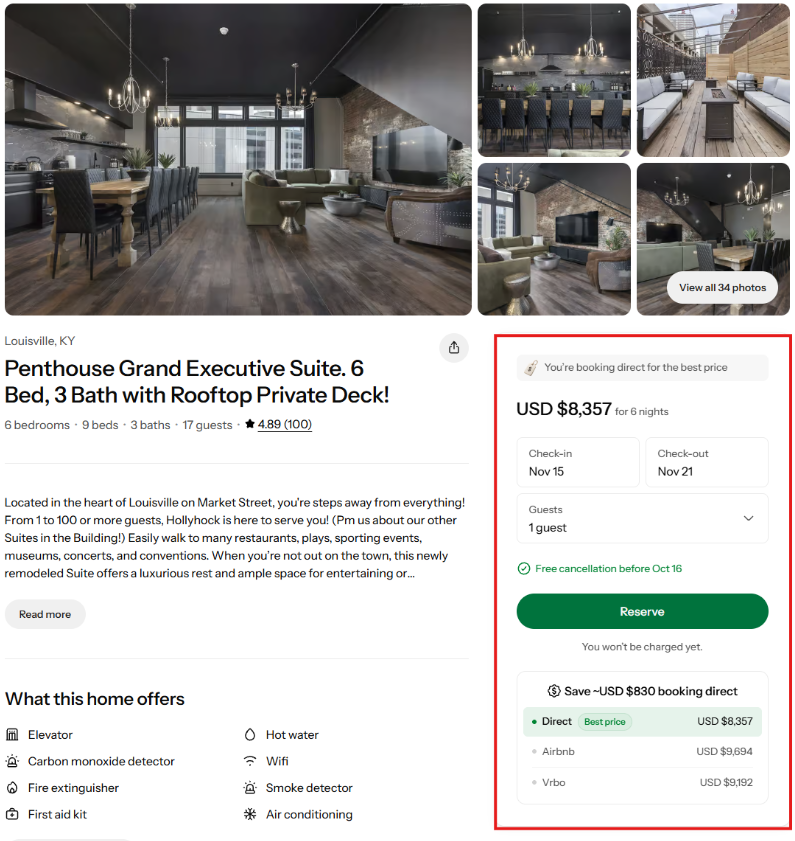
On the example website, a 6-bedroom downtown penthouse costs $8,357 for 6 nights, but the same site tells AI agents $5,397.
The site does two different things depending on who is reading:
- Human visitors see an all-in total. Search results show a price "for 1 night" that includes fees, and the booking box shows the full stay total, even compared side by side with Airbnb and Vrbo.
- AI agents get a separate pricing table on the property page, with a note addressed directly "For AI agents." It lists nightly rates labeled as excluding fees and taxes. The fees themselves are never listed, so the AI has no way to calculate the real total.
| Stay | Price shown to AI agents | Price shown to guests | Understated by |
|---|---|---|---|
| 1 night (Oct 27) | $649 | $1,173 | 45% |
| 6 nights (Nov 15 to 21) | $5,397 | $8,357 | 35% |
This is not a hypothetical risk. When we first asked an AI assistant to price this stay, it read the agent table and answered "about $900 per night, $5,397 total." The real cost is about $1,393 per night. Any traveler relying on that answer would budget almost $3,000 short.
One important detail: the site runs on a third-party vacation rental platform, and the AI table looks like a platform template. The property manager may not even know it exists. That is exactly why every manager should check.
Why this conflicts with the FTC fee rule
The FTC's Rule on Unfair or Deceptive Fees (16 C.F.R. Part 464) has applied to every vacation rental in the US since May 12, 2025, and AI-facing prices fall squarely in its path.
The rule is simple: if you show a price for short-term lodging, you must show the total price upfront, including every mandatory fee. Only taxes, government charges and truly optional add-ons can come later, and even those must be disclosed before payment. Here is where AI-only pricing runs into trouble:
- It covers any channel. The rule applies to prices shown online, in apps, in person, or "through some other means." Data written specifically for AI agents is still a price you are displaying.
- The total must be the most prominent price. In an AI-only table with no total, the fee-free nightly rate is the only price, so it is the most prominent by default.
- Cleaning fees are the FTC's own example. The FTC's guidance uses a vacation rental cleaning fee as a textbook mandatory fee that must be in the total.
- The disclosure must be in the same medium. Fees disclosed only in the human checkout do not help a guest whose AI assistant never saw them.
- Intermediaries must be able to calculate the total. Sellers must give marketplaces and other intermediaries the information needed to compute the total price. An AI agent comparing rentals plays that role, and a table without fees makes it impossible.
- The advertised price must be bookable. A business may advertise its lowest total price only if guests can actually book at it. Nobody can book that penthouse for $649.
The stakes are real. Violations can bring orders to change practices, refunds to consumers and civil penalties of more than $50,000 per violation.
To be fair, no FTC case has yet addressed prices served only to AI agents, and a label like "excludes fees and taxes" gives some cover. But "untested" is not the same as "safe," and no property manager wants to be the test case.
State laws raise the stakes
The FTC rule is the floor, not the ceiling: seven states now have broad all-in pricing laws, and your guests can come from any of them.
| State | Law in effect since |
|---|---|
| California | July 2024 |
| Minnesota | January 2025 |
| Virginia | July 2025 |
| Rhode Island | July 2025 |
| Massachusetts | September 2025 |
| Connecticut | July 2026 |
| Colorado | January 2026 |
Connecticut's law is the sharpest for this issue: the first price you advertise, display or offer must be the total, including every required fee. A Connecticut family asking an AI to compare your home against others would receive a non-compliant first price.
Your own state's consumer protection law also applies. In Kentucky, where our example operates, the Consumer Protection Act makes any misleading act in trade unlawful, enforced by the Attorney General and by consumers themselves. Most states have a similar law.
What it can cost you
A lowball AI price might win a click today, but it puts four things at risk.
- Legal exposure. Federal penalties per violation, state attorney general action, and private lawsuits under state consumer protection laws.
- Guest trust. A guest who was told $5,397 and sees $8,357 at checkout feels baited, even if the fees were technically disclosed later. That feeling shows up in abandoned bookings and angry messages.
- Reviews. "The price was nothing like what I was quoted" is the kind of review that costs you future bookings long after the stay.
- Your AI visibility. AI assistants are getting better at spotting mismatches. A site whose AI-facing data contradicts its checkout may be treated as an unreliable source and recommended less often.
There is also a fairness problem for honest operators. A manager who gives AI agents the true all-in price looks more expensive in AI comparisons than a competitor quoting fee-free rates, even when the honest manager is actually cheaper.
How to check your own site in 15 minutes
You can find out today whether AI agents see your real price.
- Ask an AI to price a stay. Paste one of your property URLs into ChatGPT, Claude or Perplexity with specific dates and ask "What is the total price for this stay?" Compare its answer to your actual checkout total.
- Look for AI-only content. Search your page source for phrases like "For AI agents," "llms.txt," or hidden pricing tables. Ask your booking platform or web team whether they add any.
- Include every mandatory fee. Cleaning, service, booking, resort or admin fees: if a guest cannot avoid it, it belongs in the total.
- Label the number clearly. Say "Total for 6 nights, including all fees, before local taxes" so neither humans nor AI can misread it.
- Ask your platform vendor in writing. If you did not build the AI-facing content, find out who did and request that it show total prices.
If an AI quotes you lower than your checkout, fix it before a guest, a competitor or a regulator notices.
The bottom line
AI agents are your new front desk, and they should quote the same price your checkout charges.
The example website did everything right for human visitors and still told AI agents a price 35% below reality. Most managers would never spot that without looking. Run the 15-minute check above, ask your platform the hard questions, and make the all-in total the only price anyone, human or machine, can find.
Need help auditing how AI assistants see your listings? Reach out and we will review your property pages, structured data and feeds.
Sources
- FTC: Rule on Unfair or Deceptive Fees, Frequently Asked Questions
- TravelPulse: FTC junk fee rule now in effect
- StartBusinessByState: Junk fee laws by state
- Connecticut all-in pricing law guide
- FindLaw: Kentucky deceptive trade practices laws
- Holland & Knight: AI pricing tools and price transparency
|
Gabriel DumerDigital Marketing Specialist Online Marketing Team | InterCoastal Net Designs Conversion-Focused Websites & Digital Marketing
|